
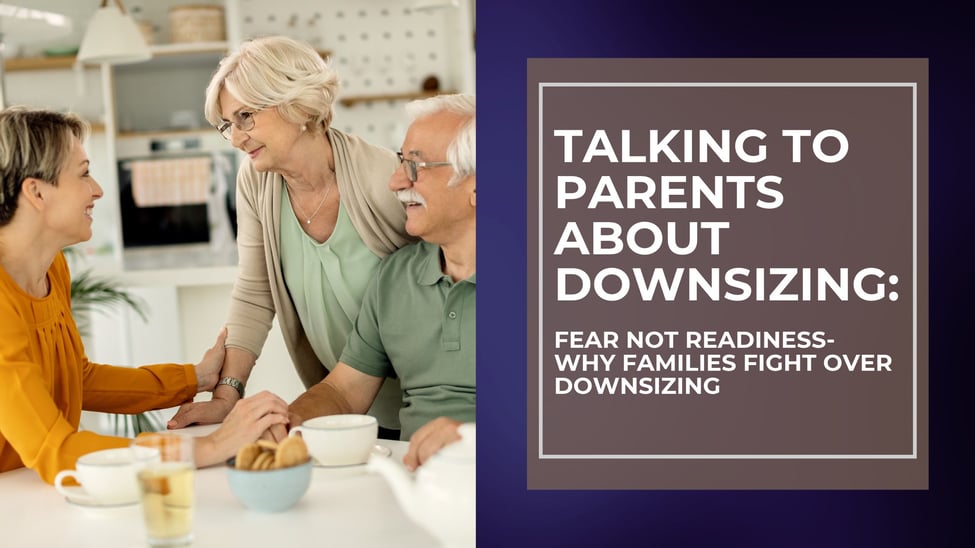
Talking to Parents About Downsizing: Why It’s Fear, Not the House Talking to parents about downsizing is one of the hardest conversations a family can have. And most of the time, it goes sideways for a reason nobody says out loud. The fight isn’t really about the house. It’s about fear. Adult children are afraid something will happen to a parent who lives alone. Parents are afraid that moving means losing their independence, their memories and their say over their own future. Both sides are acting out of love. Neither side feels heard. On a recent episode of Real Estate Without The Noise, we sat down to talk about why these conversations get so emotional, and how families in Ontario can talk about the future without turning it into a battle over the house. Why do families fight over downsizing parents? Start with the adult child. In this stage of life, the “child” might be 50, 60 or even 70. They may be raising kids, running a business and keeping up their own home. Now they’re also cutting a parent’s grass, booking doctor’s appointments and paying bills. In most families, one person ends up carrying most of that load. Often it’s a daughter, sometimes the eldest, sometimes the youngest. All three of us have seen it in our own families. When you’re that stretched, worry turns into pressure. It comes out as, “Mom, you need to move.” Now look at it from the parent’s side. They hear, “You’re taking away my independence.” They hear, “You want to control me.” They raised a family in that house. For a widowed parent, the house can still hold the person they lost. Leaving it can feel like giving up part of their life. What looks like a tug-of-war over control is really love on both sides of the table. You can’t fight emotion with logic Adult children usually come to this conversation with logic. The house is too big. The roof and windows will need replacing. Money may be tight, and upkeep is getting harder. All of that may be true. And none of it lands, because the parent is coming from emotion. As one of us put it on the show, you can’t fight emotion with logic. You have to acknowledge the feelings first. A parent who doesn’t feel heard will never get to the point of thinking, “Okay, this makes sense for me.” So try starting somewhere else. “You raised us in this house. There are so many memories here. And now you have the chance to give that gift to another family.” That speaks to the heart of it. Some families even find it helps to gather everyone, tell the old stories, laugh, cry and let the grieving happen before anyone talks about listings. When should seniors start planning to downsize? Earlier than you think, and long before anyone needs to move. Evelyn saw this with her own parents. When her dad was very sick, his palliative doctor pushed the family to get his name on a care list, even though nobody felt ready. When the time came that home care was too much, he was able to get in. That early step gave the family a choice when they needed it most. People don’t resist change. People resist being forced to change. Planning early means nobody has to be forced. Try building a simple plan together. Where do you want to be in five years? In ten? What happens if a big health change comes along? These plans aren’t final. They’re a way to know your options before a fall or a hospital stay chooses for you. Rightsizing, not downsizing The word downsizing makes a lot of people feel like their life is shrinking. We prefer rightsizing. The right home might be smaller. It might be the same size with everything on one floor. It might be assisted living, or a community where someone else cuts the grass and clears the snow. For some people, the deciding factor isn’t space at all. One of our neighbours chose assisted living on her own because she wanted company. And one of our dads, at 93, lives happily on his own but gets miserable when he goes days without seeing people. Ask what matters most. Is it being social? Being able to get around the house easily? Staying close to family? The answers will point to the right fit. What to do with parents’ furniture when downsizing For many parents, the stuff is the scariest part. A generation ago, the china and the dining set got passed down. Today, most adult children already have what they need. And it’s hard to hear, “We paid $6,000 for that,” when the table is 40 years old and well loved. Here’s what helps. People let go more easily when they know where things are going. One of us watched her father refuse to part with anything after a flood. Then she mentioned that two young men in the family could use his dress shirts. He lit up and said, “Take them all.” Find a person, a newcomer family or a charity that will value it, and letting go starts to feel like giving. Start the conversation early You don’t have to solve everything in one talk. Keep the lines of communication open and let the plan grow over time. If you’re in your 50s or 60s, start thinking about your own next move now, so your kids never have to push. And remember, this is really all about love. If your family is starting this conversation in Caledon, Brampton, Etobicoke or anywhere in the GTA, we’d be glad to help you look at your options. Listen to the full episode of Real Estate Without The Noise here: [episode link] Show email: [email protected] Listen and watch: Podcasts [Apple Podcasts link] | YouTube https://www.youtube.com/@RealEstateWithoutTheNoise |
4f. Newsletter Segment
[Host greeting] This month on Real Estate Without The Noise, we talked about a conversation a lot of families are putting off. Talking to parents about downsizing. Here’s what stuck with us. The fight is rarely about the house. Adult children are worried about a parent living alone, and parents are worried about losing their independence and their memories. Everyone is acting out of love, and nobody feels heard. Feelings come before facts. You can’t talk someone out of an emotion with a list of reasons. Acknowledge what the house means first, and the practical side gets easier. Planning early protects your choices. A simple five, ten and twenty-year plan means a fall or a hospital stay never makes the decision for you. And yes, we talked about the furniture. Your kids probably don’t want the dining set, and that’s okay. Listen to the full episode here: [episode link] [Host sign-off] Show email: [email protected] Listen and watch: Spotify [Spotify link] | Apple Podcasts [Apple Podcasts link] | YouTube [YouTube link] |